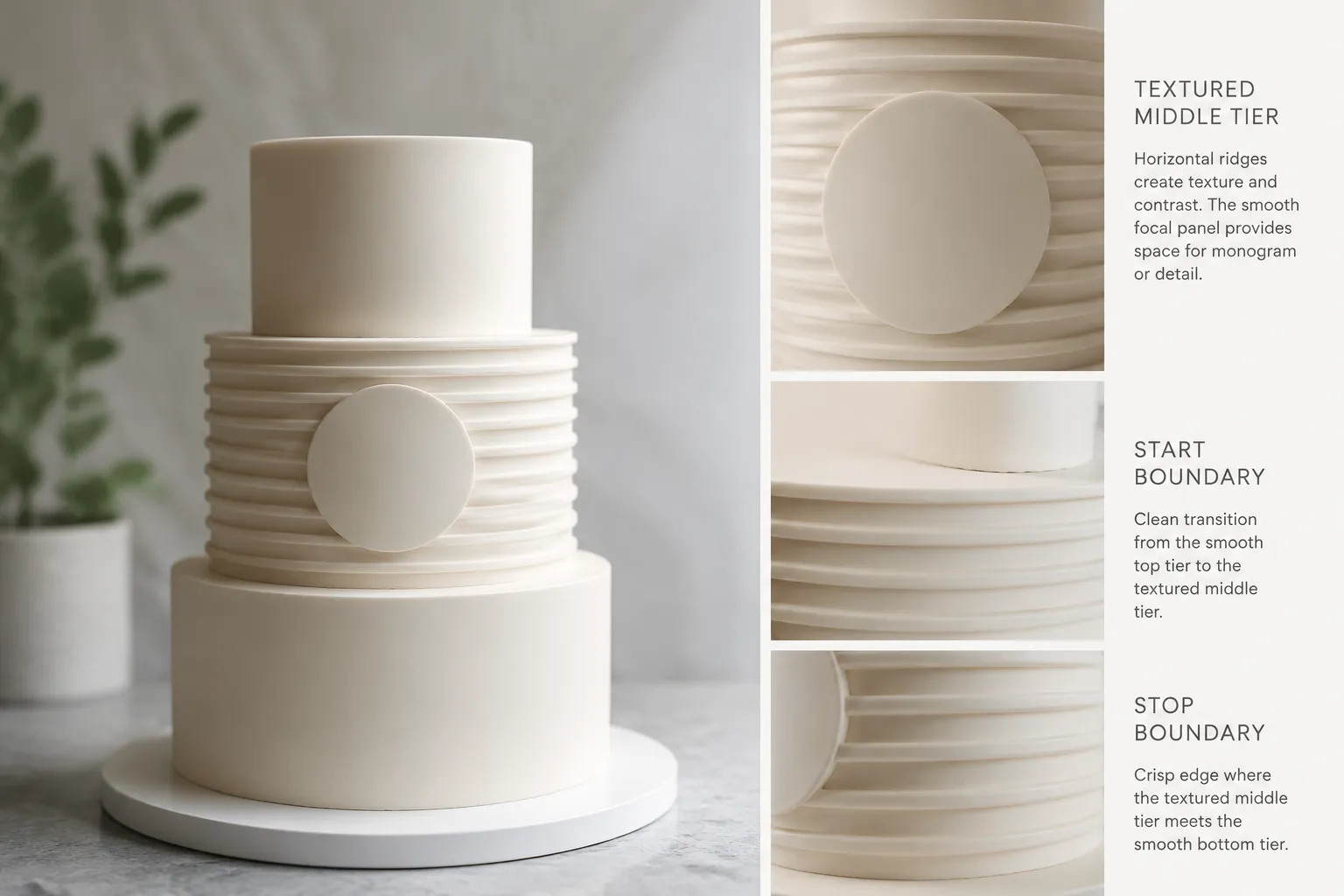
Ridged and Combed Cake Finish Options
A ridged cake finish usually takes one of two visible routes: piping adds raised texture, while combing or scraping forms repeated grooves in the outer frosting. Choose between them by comparing profile, spacing, edge quality, direction, and placement rather than relying on the broad word “textured.”

The reference can show the finish direction, groove scale, and location. It does not establish the frosting system, ingredients, storage requirements, transport performance, structural behavior, price, serving yield, venue acceptance, or exact reproduction.
Ridged versus combed cake finishes
| Feature | Piped texture | Combed or scraped texture |
|---|---|---|
| Surface form | Raised ribbons, ruffles, rosettes, stars, or other applied profiles | Repeated grooves shaped through the frosting surface |
| Visual depth | Usually more dimensional and pronounced | Usually flatter, with depth affected by the tool and pressure |
| Spacing | Set by tip size, movement, pressure, and overlap | Set by comb or scraper teeth, alignment, angle, and movement |
| Edge quality | Rounded, folded, scalloped, or sharply defined | Soft, crisp, shallow, or deliberately uneven |
| Direction | Often follows a piped motif or selected placement | May run horizontally, vertically, diagonally, or around the cake |
| Surface rhythm | Layered or ribbon-like | Continuous, linear, or intentionally irregular |
| Focal-detail relationship | Larger raised elements may compete with other decorations | Fine grooves can recede, while broad grooves may become the dominant detail |

Wilton’s piping terminology helps distinguish profiles such as ribbons, ruffles, rosettes, and stars. Its examples show raised surface treatments, but they do not establish that a particular photographed finish is feasible for every bakery.
The production route belongs in the brief. “Textured” is too broad when the intended result depends on narrow, regular grooves rather than raised piping.
What the groove profile communicates
Inspect the groove itself. Is it narrow and sharply separated, broad and shallow, rounded at the edges, or interrupted by visible changes in pressure?
Closely spaced grooves usually read as denser and more continuous. Wider spacing gives each ridge more visual weight. The image suggests this relationship, but final width and spacing depend on the selected tool and working process.
An irregular ridged cake finish uses variation as part of its appearance. The grooves may shift slightly in width, depth, or direction. Specify the acceptable variation instead of relying on “messy,” which can describe either intentional movement or an unwanted break in continuity.
- Narrow, closely repeated grooves
- Broad grooves with visible separation
- Soft edges rather than sharp channels
- Consistent horizontal direction
- Slight variation between passes
- Texture concentrated on one tier or panel
- A smooth upper tier or focal area
- Irregularity limited to a defined section
These details give the producing bakery a clearer target than “rustic yet elegant,” a phrase that often functions as promotional visual language rather than a measurable finish brief.
Piped versus combed cake texture
Piping places frosting onto the surface. The tip, bag pressure, movement, and overlap determine the resulting profile, which may appear as ribbons, ruffles, rosettes, stars, or repeated lines.
Combing and scraping shape or remove frosting across the surface. A bench scraper or decorating comb can create channels, with groove width and spacing influenced by the teeth, rigidity, angle, alignment, and movement.
A Zoe Bakes tutorial demonstrates one approach using a scraper or decorating comb held vertically or at approximately a 20-degree angle. That is an attributed handling example, not a universal angle or required specification. A different frosting system, cake shape, tool, or finish direction may require another method.
“Will the texture be piped as raised ribbons, or formed by combing and scraping the outer frosting?”
This clarification prevents two references from being treated as interchangeable when their surface profiles are produced differently.
Groove width, spacing, and direction
Texture scale should relate to the cake’s visible area and focal details. Fine grooves can support a larger plaque, topper, floral arrangement, or piped accent. Broad ridges carry more visual weight and may dominate a tier.
- Horizontal grooves: Emphasize the circumference and can make a tier read as banded.
- Vertical grooves: Draw attention to the height of the tier.
- Diagonal grooves: Introduce directional movement.
- Circular or curved grooves: Reinforce the round form.
- Mixed directions: Create a busier surface and need more precise placement instructions.
State where the texture begins and stops. A fully covered tier reads differently from a partial panel, a single textured band, or a finish that fades into a smooth section.
- “Texture covers the full side of the middle tier.”
- “Leave a smooth vertical panel for the focal decoration.”
- “Begin the ridges below the top edge.”
- “Keep the top surface smooth.”
- “Stop the grooves before the lower border.”
The reference does not prove how a transition was produced. Ask the bakery whether the planned tools and frosting can create the requested boundary with the intended continuity.
Regular or deliberately irregular?
Regularity separates a controlled combed finish from an informal ridged finish. A tightly repeated pattern needs alignment, spacing, and continuity; a deliberately irregular pattern still needs limits.
| Vague description | More useful brief language |
|---|---|
| Neat comb design | Even groove spacing with continuous horizontal alignment |
| Messy texture | Slight changes in groove depth and spacing, without unintended gaps |
| Soft edge grooves | Rounded transitions between channels and ridges |
| Professional-grade finish | Defined edge profile, consistent placement, and no unintended interruptions |
| Rustic texture | Deliberate irregularity limited to width, depth, or direction |
Words such as “easy,” “stable,” and “professional-grade” may appear in creator or supplier marketing, but they do not verify the result for a specific order. The producing bakery should state what degree of variation is practical for the selected finish.
Frosting consistency and tool handling
Frosting consistency is a production variable, not a detail that can be inferred from a photograph. One creator troubleshooting example suggests that very stiff buttercream may tear during combing, but that remains a limited planning prompt rather than a general rule.
Ask the bakery to confirm:
- Which frosting system is planned
- Whether it needs a particular working consistency
- Whether that consistency supports the requested groove depth
- Whether chilling forms part of the process
- Which comb, scraper, or piping tip creates the intended profile
- How the tool will align at the cake board and upper edge
- How gaps or breaks in the pattern will be handled
A large round piping tip, bench scraper, scalloped comb, spoon, or informal tool can produce different surface results. These are alternative production routes, not evidence that the tools are equivalent.
If the reference depends on a particular comb-tooth pattern, include a close crop or annotated detail. A full-cake photograph may not reveal whether the grooves were cut by a straight scraper, toothed comb, or applied piping.
Focal-detail compatibility
Review the ridged finish against the size and placement of the main focal detail. Fine, even grooves may support a large smooth plaque or simple topper, while broad or irregular texture can compete with small lettering, narrow borders, or delicate floral detail.
- Groove width compared with lettering stroke width
- Texture scale compared with border thickness
- Texture direction compared with the focal detail’s shape
- Smooth space available around the focal detail
- Contrast between the finish and the decoration
- Whether the detail sits over, beside, or within the ridged area
“Make the texture the background” is incomplete unless the brief identifies how much smooth space remains. Mark the focal area and state whether the grooves should continue behind it.
What a reference cannot confirm
A finished photograph provides useful evidence about visible form, but it leaves order-specific questions open. Do not infer the following from appearance alone:
- Ingredients or allergens
- Food-contact suitability
- Storage duration or display requirements
- Transport performance
- Structural stability
- Serving yield
- Price or availability
- Venue acceptance
- Exact reproduction of the photographed finish
Research about batter, crumb structure, ingredients, or baking conditions may help separate the cake substrate from the external icing finish. It does not verify the performance of a particular ridged or combed frosting.
For an actual order, ask the producing bakery and venue to confirm the handling, display, transport, and food-contact requirements that apply to the specific cake.
A precise bakery handoff
A usable brief can describe the finish in one compact paragraph:
“Use a combed ridged finish on the sides of the middle tier. The grooves should run horizontally, with medium width, soft edges, and mostly regular spacing. Keep the texture continuous around the tier, but leave a smooth panel at the front for the focal detail. The top surface should remain smooth. Please confirm the frosting system, planned working consistency, comb or scraper profile, and whether the requested spacing and transition are feasible.”
For a piped version, make the method explicit:
“Use raised piped ribbons rather than scraped grooves. Keep the ribbons narrow and vertically aligned on the lower tier, with even spacing and a smooth upper tier. Please confirm the piping tip, ribbon width, overlap, and how the finish will meet the border.”
Retain these questions in the handoff:
- Is the finish piped, combed, scraped, or combined?
- What groove or ribbon width is intended?
- Should spacing be regular or varied?
- Are the edges soft, rounded, scalloped, or defined?
- Which direction should the texture follow?
- Where does it start and stop?
- Does the focal detail require a smooth panel?
- Which frosting system and working consistency are planned?
- Could the selected tool or production conditions require a revision?
The strongest reference is the one that makes profile, scale, spacing, direction, placement, and production questions visible. Mark those choices on the brief, then leave the bakery to confirm the method and feasibility.