
Clustered vs Cascading Cake Decorations
The practical distinction is placement: clustered cake decorations concentrate visual weight in selected areas, while cascading decorations create a directional path across the cake.
Choose a cluster when the brief needs one clear focal detail, controlled density, and visible open space. Choose a cascade when the decoration should move from the top toward the sides or down the tiers. Neither layout is automatically better; the choice depends on the cake silhouette, tier ratio, decoration scale, spacing, finish, and production constraints.

Clustered Cake Decoration Placement
A cluster groups flowers, dots, pearls, leaves, or related details into a compact visual unit. It may sit on the top, one side, or selected areas across several tiers.
Documented cake projects show flowers arranged in groups on the top and sides, while piping instructions describe individual dots oriented toward a center to create a grouped motif. These are useful reference examples, not universal layout rules.
A cluster gives the eye a defined stopping point. A brief might specify:
- One large focal group on the upper tier
- Smaller supporting groups on one or two lower tiers
- Clear icing visible around the main detail
- Repeated dots, pearls, or flowers contained within a controlled area
- Candles, toppers, or another top function kept outside the focal group
The result depends on more than the number of decorations. A dense group of small dots reads differently from a sparse group of large flowers, even when both occupy a similar area. Smooth icing, piped texture, fondant shapes, leaves, and connecting lines also change the edge and surface rhythm.
The reference image does not establish whether the decoration is edible, how it is attached, or whether the same arrangement suits another tier height. Ask the producing bakery to confirm the material, attachment method, top clearance, and whether the group continues around the back.
Cascading Cake Decoration Placement
A cascade arranges details along a visible direction. A top-to-side cake cascade may begin near the top and travel diagonally, vertically, or in a broken path toward the sides or lower tiers.

Flowers, piped buttercream forms, leaves, sprinkles, dots, or connecting lines can create that direction. A documented floral cake project shows how varied forms and textures can be combined along a path, but it does not establish a formula for every cake.
A cascade needs a readable start and finish. Without those points, separated decorations may look randomly distributed rather than intentionally directional. Mark these decisions in the brief:
- Where the cascade begins
- Which tier or side receives the largest focal detail
- Where the visual path ends
- Whether elements become smaller, lighter, or more widely spaced
- Whether the pattern continues around the back
- How much cake finish remains visible between elements
The producing bakery still needs to assess how the direction works with the cake’s actual height, tier ratio, and finish. A path that reads clearly on a tall, narrow profile may become compressed on a wider or more closely stacked cake.
Clustered Versus Cascading Cake Decorations
| Criterion | Clustered placement | Cascading placement |
|---|---|---|
| Main visual effect | Concentrated emphasis | Directional movement |
| Placement pattern | Compact groups in selected areas | A connected or implied path across tiers |
| Focal detail | Usually localized | Distributed along a route |
| Spacing | Tighter within the group, wider outside it | Varied along the path to maintain direction |
| Silhouette | Leaves more areas visibly open | Interacts with more of the cake profile |
| Briefing priority | Group size and position | Starting point, ending point, and direction |
| Main unknown | Whether the group overwhelms the tier | Whether the path remains balanced at full scale |
This comparison describes visible layout behavior. It does not establish stability, transport performance, storage requirements, serving quantity, price, availability, ingredient identity, allergen status, venue acceptance, or exact reproduction.
Silhouette and Tier Ratio
Judge cake decoration placement against the cake’s profile, not only against a flat reference image.
A cluster can emphasize a tier edge, top surface, or corner. Its position may make the tiers appear more separated, especially when the cake has visible spacing or a clear change in width between levels.
A cascade interacts with the full vertical structure. The direction may follow an outer edge, cross a tier boundary, or pause between tiers. When the tiers are similar in width, clearer scale changes or spacing may be needed. When the tier ratio changes sharply, the path may need revision at each level.
Record these details before choosing the layout:
- Number of tiers
- Approximate width relationship between tiers
- Visible height of each tier
- Whether the cake is round, square, or another shape
- Which sides face the main viewing area
- Whether the back needs matching coverage
A reference shows one profile under one viewing condition. It cannot prove that the same cake decoration silhouette will result on a different tier arrangement.
Scale, Spacing, and Density
Scale describes the relationship between each decoration and the tier beneath it. Spacing is the distance between elements or groups. Density describes how much of the visible surface they occupy.
Keep these decisions separate in the brief. Words such as “abundant,” “light,” or “impactful” do not tell the bakery where the elements belong. Replace them with observable instructions:
- One large focal flower with smaller supporting forms
- Tight grouping near the starting point
- Wider spacing toward the end
- Deliberate gaps between clusters
- Low piping density on the front face
- More texture at the center, with a quieter edge
- Repeated elements kept visually separate rather than joined
A cascade often uses changes in scale and spacing to show direction. A cluster usually relies on proximity and shared shape to show grouping. These are tendencies, not fixed rules.
Focal Detail and Finish
The focal detail establishes visual priority. It may be the largest flower, the densest piping, a contrasting center, or a change in texture.
In a cluster, the focal detail usually sits inside or beside the group. Supporting elements can repeat its color, edge, or material without matching its size.
In a cascade, the focal detail may sit at the beginning, middle, or lower end of the path. Its position changes the direction noticed first. A large form near the top creates a different reading from a large form near the middle tier.
Finish matters because decoration sits against a specific surface. Smooth buttercream, textured piping, fondant, ganache, sharp edges, soft edges, and visible borders can either support or compete with the placement. State whether the decoration should contrast with the finish or blend into it.
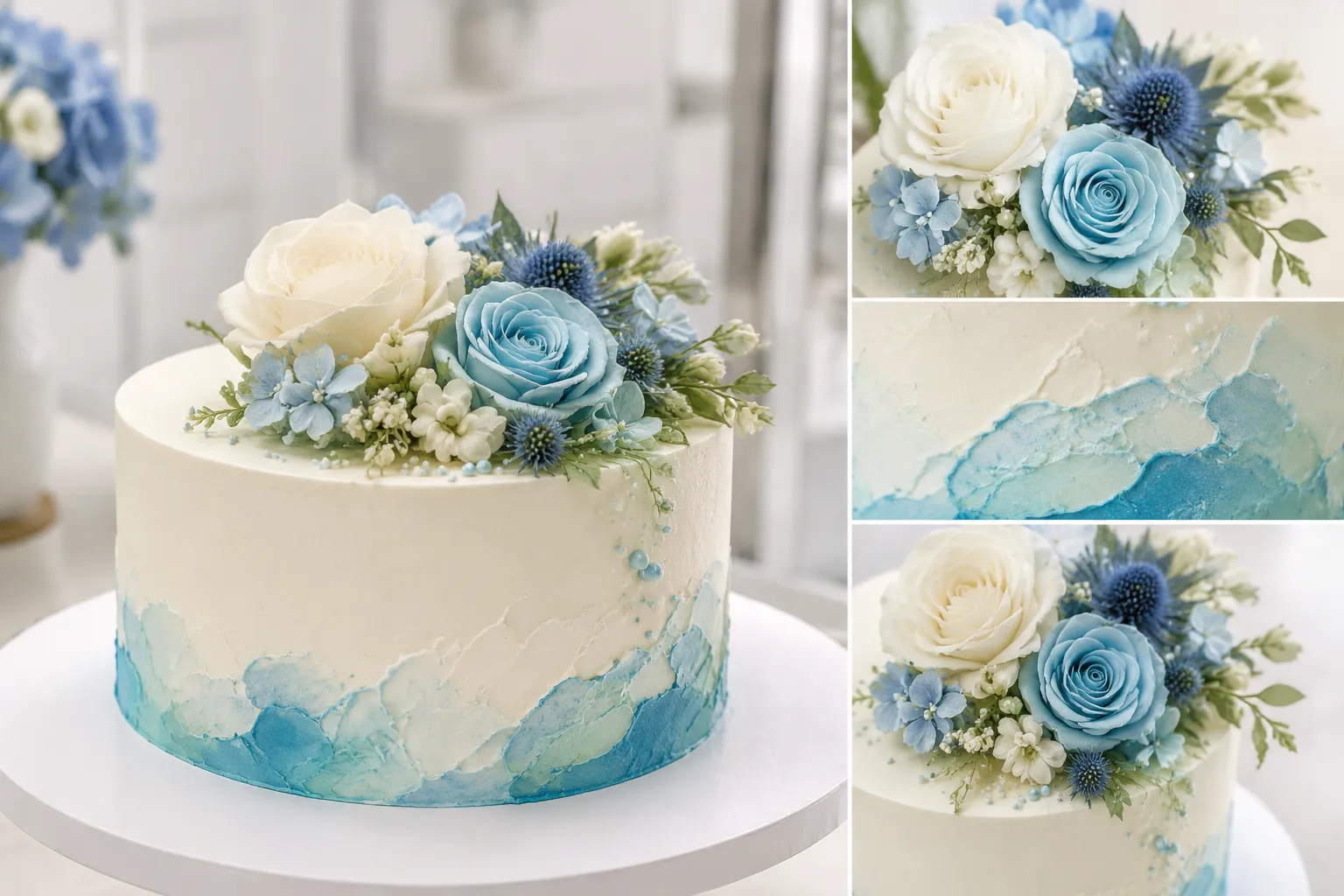
Distributed floral examples can show how flowers, leaves, connecting lines, and center details create continuity across separated areas. Use that arrangement as a placement reference, not as a third universal category or a project specification.
Turn the Choice Into a Bakery Brief
Start with the layout, then specify the details that make it identifiable.
For a Clustered Layout
Use two concentrated decoration groups: one on the top edge and one on the front-facing side. Keep the largest detail in the upper group, with smaller elements gathered close to it. Leave clear icing visible between the groups and reserve the top center for the planned function.
For a Cascading Layout
Create a diagonal path from the upper left of the top tier toward the right side of the lower tier. Begin with the largest focal detail, reduce the scale gradually, and leave visible gaps between elements. End the path before the back edge unless full back coverage is confirmed.
Add the production-facing decisions:
- Decoration material and finish
- Largest and smallest element
- Intended scale on each tier
- Tight or separated spacing
- Piping density
- Edge shape and border treatment
- Attachment method
- Front-only or full-circumference coverage
- Clearance for candles, toppers, cutting, or other top functions
- Storage and transport questions for the producing bakery to assess
Mark the reference with arrows or short labels. Identify the focal detail, group boundary or direction, largest element, quietest area, and intended viewing side. A marked image gives the bakery more usable information than the layout name alone.
Food-Contact and Non-Edible Decoration Questions
Flowers, wires, supports, barriers, dusts, and other decorative materials can introduce order-specific food-contact and handling questions. FDA guidance provides a narrow boundary for distinguishing edible and non-edible or non-nutritive decorative products; it does not certify a particular flower, support, barrier, supplier, or finished cake.
Ask the producing bakery and venue to confirm:
- Which flowers or decorative materials will be used
- Whether any element touches the cake directly
- Whether a barrier or support is required
- How supports and non-edible items will be removed
- Whether the venue has its own handling or removal requirements
The reference image cannot establish food contact, ingredient identity, allergen status, or suitability for a specific order.
Quick Placement Check
Inspect the preview from the intended viewing angle. A layout that works from the front may change when the cake is viewed from the side.
For a Cluster
- Is the focal group visibly concentrated?
- Does the group have a clear outer boundary?
- Is the largest detail easy to identify?
- Does the surrounding open space remain intentional?
- Are candles or other top functions unobstructed?
For a Cascade
- Can the eye follow a clear starting point?
- Does the direction continue across the intended tiers?
- Does the scale change support movement?
- Are the gaps deliberate rather than accidental?
- Does the ending point look resolved?
- Does the front-to-back coverage match the brief?
If the answer changes at another viewing angle, revise the brief to name the priority side and the required coverage.
What the Preview Cannot Confirm
A rendered, photographed, or tutorial reference can show placement, relative scale, visible density, finish, and silhouette. It cannot by itself confirm structural performance, transport conditions, storage requirements, serving quantity, price, availability, exact material identity, allergen status, venue acceptance, or exact reproduction.
The available material documents selected decorating projects and methods, but it does not provide an independent comparison, field test, or order-level feasibility assessment. Keep those details in the producing bakery’s confirmation.
The Short Decision
Use clustered cake decoration placement when the brief calls for concentrated emphasis, distinct focal groups, and more visible open space.
Use cascading cake decoration placement when the brief calls for a readable path from the top toward the sides or down the tiers.
For the handoff, state the starting point, ending point, largest detail, scale by tier, spacing, density, finish, back coverage, and top clearance. Then ask the producing bakery to confirm materials, attachment, food contact, supports, transport, storage, and removal requirements.