
Cake Decorations and Placement
Cake decorations change more than color. Their placement affects the visible balance of the cake, the relationship between tiers, and the questions a producing bakery must answer.
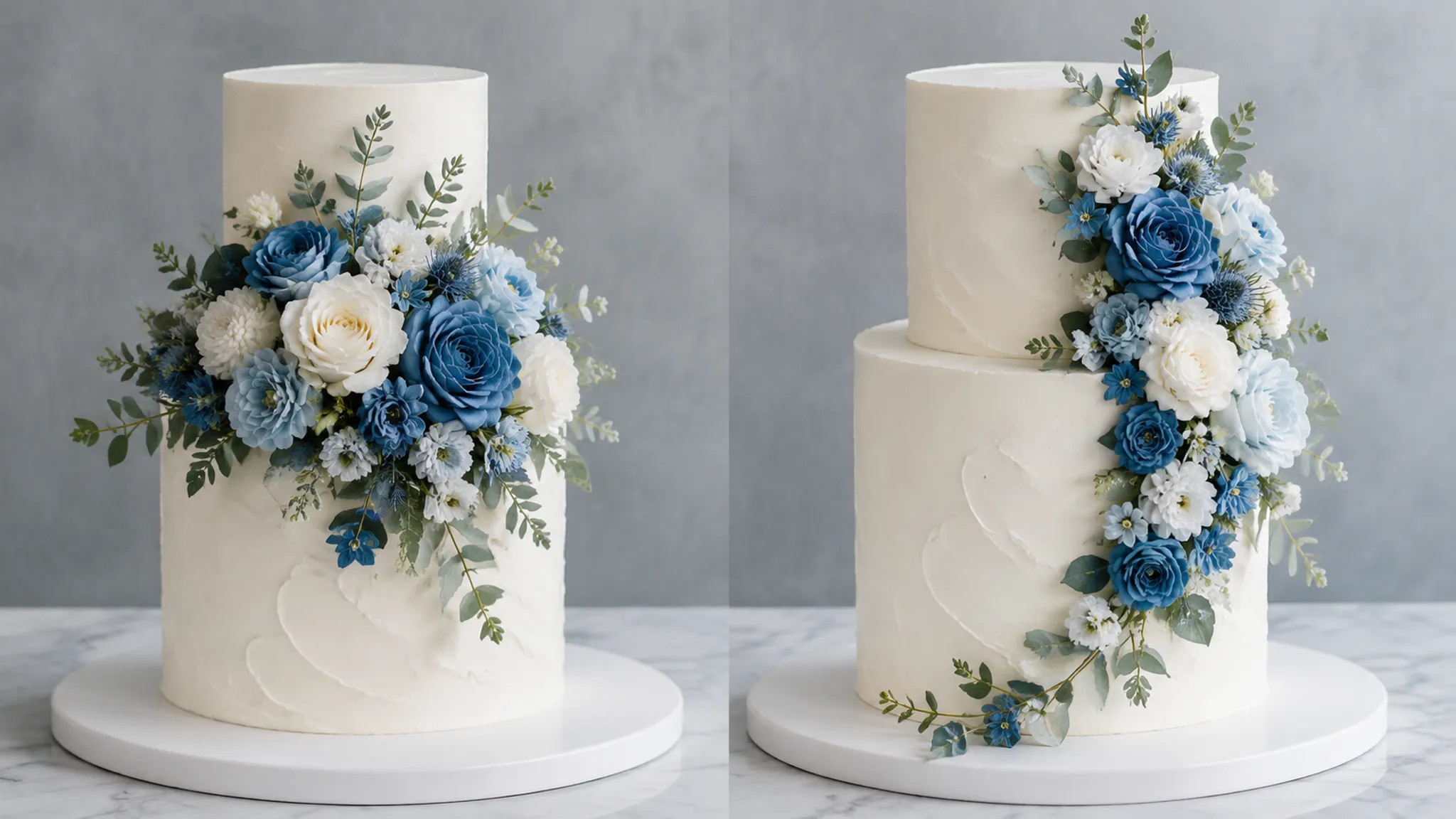
A compact cluster concentrates attention in one area. A cascading arrangement directs the eye across the cake profile. Piping and borders can define an edge, repeat a rhythm, or give a tier a more structured outline. A reference image shows the intended appearance, but it does not establish ingredients, stability, servings, transport performance, venue acceptance, price, availability, or exact reproduction.
The useful comparison starts with visible variables: scale, spacing, density, edge shape, focal placement, finish, and tier ratio. Resolve the preference first, then separate the production details that still need confirmation.
More specific pages
These pages continue the topic in smaller, more specific directions.
Clustered vs Cascading Cake Decorations
Clustered and cascading decorations are sometimes treated as interchangeable labels. They create different visual paths and require different information in the brief.
Clustered Cake Decorations
A clustered arrangement groups several details within a defined area. The group may sit near the top edge, beside a tier junction, around a topper, or on one side of the cake.
The reference shows concentration rather than continuous movement. The selected area becomes the main focal point while the surrounding cake remains relatively open.

When reviewing clustered cake decorations, record:
- the approximate width and height of the group;
- its distance from the top, bottom, and nearest tier edge;
- whether it is centered, offset, or asymmetrical;
- the size difference between the largest and smallest details;
- the amount of visible cake surrounding the group;
- whether the cluster repeats on another tier;
- whether piping, borders, or surface texture connect it to the rest of the cake.
A small group on a broad tier may read as restrained. The same group on a narrow tier can appear crowded, especially when a border or topper occupies the same area. The image does not establish how the cluster will be attached or whether the proposed spacing remains practical during handling, so ask the producing bakery to assess those points.
Cascading Cake Decorations
A cascading arrangement creates a directional path across the cake. Details may move diagonally from one tier to another, descend from a focal area, or change width as they follow the silhouette.
The reference shows progression rather than one concentrated stopping point. The cake profile becomes part of the composition, and the eye may travel along the arrangement.
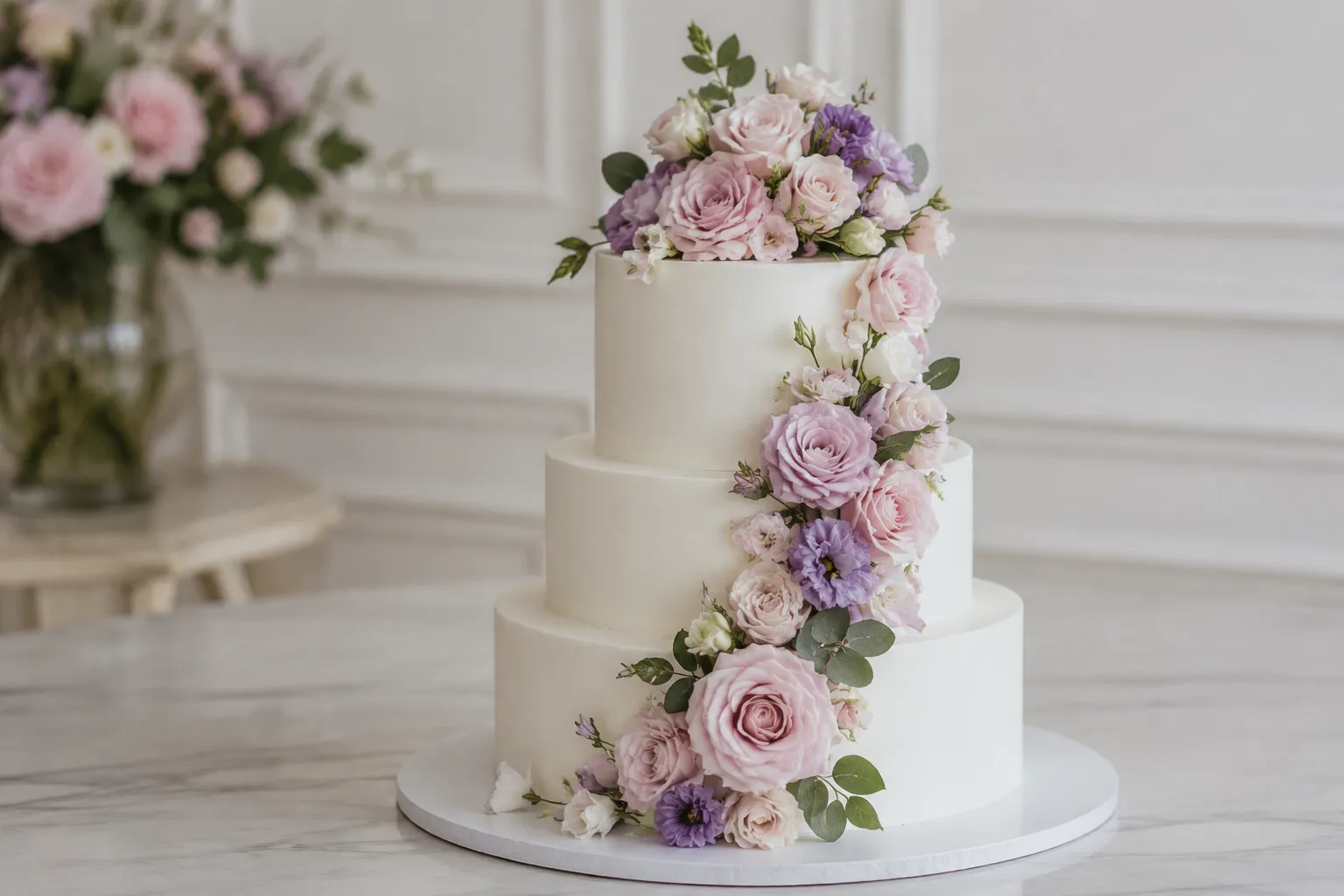
For cascading cake decorations, note:
- the starting point and stopping point;
- the direction of movement;
- the spacing between adjacent details;
- whether the path crosses tier boundaries;
- where the arrangement is densest;
- whether its visual weight increases or decreases;
- how much of each tier remains open;
- whether the route follows or conflicts with the cake edge.
“Trailing flowers” or “falling details” may describe the intended mood, but they do not define placement. A usable instruction identifies the start, direction, approximate stopping point, density changes, and areas that should remain clear.
There is no curated firsthand comparison establishing that cascading placement is more difficult or more stable than clustered placement in every setting. Feasibility depends on the cake design, decoration material, tier arrangement, handling conditions, and producing bakery.
Compare Placement Through the Same Criteria
Using the same criteria for both arrangements keeps the decision tied to the reference rather than broad labels such as “simple,” “luxurious,” or “modern.”
Scale and Spacing
Scale describes the size of a decoration relative to the cake, tier, border, and nearby details. Spacing describes the gaps between elements and between the arrangement and the cake edges.
For a cluster, scale is usually judged around one focal area. For a cascade, it must be judged across the full route. Uniform elements may create an orderly reading, while changing sizes can strengthen the sense of direction.
Describe spacing as tight or open, even or varied, concentrated near one point, gradually expanding, interrupted at tier edges, or aligned with a border. A screenshot can distort apparent distance through image scale, camera angle, and cropping, so measurements taken from it are planning estimates rather than production specifications.
Piping Density
Piping may be the main decoration, a border, a connector, or a background texture. Its density changes the amount of visual activity on each tier.
- Low-density piping leaves more of the base finish visible.
- Medium density creates a repeated surface rhythm.
- High-density piping can become the dominant texture, particularly when lines are thick, raised, or arranged in several directions.
Compare the line width, distance between lines, degree of repetition, covered surfaces, border weight, and relationship to the tier profile. Method names can vary across decorating materials, so a brief is clearer when it describes thickness, direction, spacing, and location as well.
A cake-decorating tool study examined how tool choice, icing stiffness, bag size, and tip size can affect the effort and control involved in piping. It did not compare clustered and cascading results. Its value here is limited to forming production questions: ask whether the selected piping density and tip scale suit the proposed finish, tier size, and process.
Edge Shape and Borders
The edge is where the decoration meets the cake outline. It may be sharp, rounded, scalloped, piped, ridged, or softened by a trailing arrangement.
A border establishes a clear boundary. A cluster may interrupt that boundary, while a cascade may cross it or use it as a guide. Identify the cake edge profile, border width and height, repetition across tiers, clearance from the edge, and whether the finish should appear crisp or irregular.
A thick border and dense cluster can compete for the same focal area. A narrow border may support a cascade by keeping the tier outline readable. Neither relationship is universally preferable; the intended visual hierarchy decides which conflict matters.
Focal Placement
Focal placement determines where attention settles first. It may be a topper, cluster, color contrast, tier junction, or distinctive piped detail.
A useful brief names one primary focal area and any secondary areas. Compare each option by asking:
- Where should the eye land first?
- What detail should be recognized second?
- Is the focal area centered or offset?
- Does it sit near a tier edge?
- Does the surrounding decoration frame it or pull attention away?
- Is the same focal position repeated across tiers?
A clustered arrangement usually keeps attention near one defined area. A cascading arrangement distributes attention along a route. This is a visual distinction, not proof of a particular structural or production outcome.
Tier Ratio and Profile
Tier ratio refers to the relative size and height of the tiers. Decorations should be reviewed against that profile rather than in isolation.
A large cluster may suit a broad lower tier but overwhelm a narrow upper tier. A long cascade needs enough visible surface to establish its direction, while a short cake profile may make the same route appear compressed.
Compare the width of each tier, the height between junctions, the amount of decoration assigned to each tier, the visual weight at the top and bottom, and whether the arrangement widens with the cake. Provide the producing bakery with the intended tier count, approximate proportions, and areas that must remain open.
Separate Method from Placement
Piped, bordered, clustered, cascading, scattered, and framed describe different aspects of cake decorations. They are not competing categories.
- Piped: formed through a piping method, such as lines, shells, dots, or rosettes.
- Bordered: positioned along an edge or boundary.
- Clustered: concentrated within a defined area.
- Cascading: arranged along a directional path across the profile.
- Scattered: distributed as separated details across a surface.
- Framed: positioned around a central focal area.
One cake may be piped and bordered, with a clustered focal detail. Another may combine a piped base pattern with cascading decorations made by another method.
Keep four questions separate in the brief:
- What is the decoration made or formed from?
- How is it applied or positioned?
- Where is it placed?
- How dense should the arrangement be, and which areas should remain quiet?
This prevents a material, technique, and layout from collapsing into one vague instruction.
Material Suitability and Food Contact
Material choice affects more than color and finish. Powders, dusts, toppers, coatings, metallic elements, and specialty decorations require verification for the specific proposed use.
Food-contact guidance supports a narrow question: whether a material is intended for the proposed use with food. It does not certify a named decoration for every cake, storage condition, venue, or transport plan. A public-health investigation involving decorative dust products also illustrates why a label such as “non-toxic” does not by itself establish that a product is edible or intended for consumption.
Before confirming a specialty material, ask the producing bakery or supplier:
- Is the product intended for use on food?
- Is ingredient or material information available?
- Does the finish need to be removed before serving?
- How should the decoration be handled and stored?
- Will the material remain suitable under the planned conditions?
- Does the venue have rules affecting decorative materials?
- Are toppers, metallic finishes, powders, or non-edible pieces treated differently?
The reference may show a metallic sheen, textured surface, or specialty topper. It cannot identify the product used to create that appearance.
Production Feasibility: What the Preview Leaves Open
A preview is useful for comparing form. It is not a final production specification.
The producing bakery may need to confirm whether the selected decoration can be made at the proposed scale, whether the tier profile supports the placement, and whether the spacing remains readable after production. It may also need to assess tier crossings, attachment, separate assembly, storage, transport, venue requirements, and changes caused by the final cake size.
Attach each question to the option it affects. A cascade crossing several tiers needs a different feasibility discussion from a small cluster placed on one side of the top tier. Do not ask a bakery to reproduce a reference from appearance alone; send the image with a short written brief identifying the details that matter most.
A Practical Brief for Cake Decoration Placement
A branch-level brief can specify the visual direction without pretending to settle every production detail.
- Arrangement: clustered, cascading, bordered, piped, or combined.
- Primary focal area: where attention should settle first.
- Direction: for a cascade, the starting point, route, and stopping point.
- Scale: the approximate size relative to the supporting tier.
- Density: sparse, moderate, or concentrated.
- Spacing: even gaps, outward expansion, or tighter spacing near the focal point.
- Edge treatment: border, edge profile, or clearance from the cake edge.
- Tier relationship: which tiers carry the decoration and whether the pattern repeats.
- Material questions: powders, metallic finishes, toppers, coatings, or non-edible elements requiring confirmation.
- Open decisions: feasibility, storage, transport, servings, price, availability, and venue requirements.
Use a compact cluster on the upper-right side, with the largest detail near the focal point and smaller elements opening toward the side edge. Keep the lower tier mostly clear. Use a narrow piped border only where it does not compete with the cluster. Confirm material suitability, attachment, storage, transport, and final scale with the producing bakery.
How to Review Two Cake Decoration Options
Place both arrangements against the same review grid. The purpose is to identify which option matches the resolved preference and which unanswered constraint could redirect it.
| Criterion | Clustered Arrangement | Cascading Arrangement |
|---|---|---|
| Focal placement | Concentrated in one area | Distributed along a directional path |
| Spacing | Judged around one group | Judged across the full route |
| Density | Builds visual weight locally | Can change gradually from tier to tier |
| Tier ratio | Relates strongly to the supporting tier | Relates to the full cake profile |
| Edge treatment | May frame or interrupt an edge | May follow or cross an edge |
| Revision point | Adjust the group size or location | Adjust the route, length, or density |
| Production question | Confirm scale, attachment, and local crowding | Confirm continuity, tier transitions, and handling |
Common Mix-Ups
Confusing a Cluster with a Cascade
Several decorations placed near one another are not automatically cascading. A cascade needs visible direction or progression across the cake.
Treating a Border as the Whole Arrangement
A border defines an edge, but it does not determine focal placement, density, or the tier relationship of other decorations.
Using “Minimal” Without Defining Scale
Minimal may mean fewer elements, smaller elements, more open spacing, lower piping density, or quieter color contrast. State which variable should change.
Treating a Reference Image as a Complete Order Brief
An image may hide the back of the cake, crop tier junctions, or obscure materials. Record visible details and list unknowns separately.
Assuming Appearance Proves Material Suitability or Stability
A finish that looks edible, metallic, glossy, or dusted cannot be identified reliably from appearance alone. A photograph also does not establish how the decoration was assembled, stored, transported, or handled.
FAQ
What is the difference between clustered and cascading cake decorations?
Clustered cake decorations are concentrated within one defined area. Cascading cake decorations create a directional path across the cake, often moving between tiers or down one side.
How should cake decoration placement be described?
Name the focal area, direction, scale, density, spacing, edge treatment, and tier relationship. These details are more useful than broad style labels alone.
Can piping and borders be used with a clustered arrangement?
Yes. Piping can form the cluster, frame it, connect it to another detail, or remain separate as a border. State which role it performs.
How do tier proportions affect decoration placement?
Tier width and height change how much space a decoration occupies visually. A scale that reads clearly on a broad tier may appear crowded on a narrow one, so the producing bakery should confirm the final ratio.
Are non-edible cake decoration materials suitable for direct use?
Suitability depends on the specific product and intended use. Ask the producing bakery or supplier whether the material is intended for the proposed food-contact application and whether it must be removed before serving.
Does a reference image prove that a decoration can be reproduced?
No. It communicates visible form and placement, while materials, attachment, storage, transport, final scale, and production feasibility remain order-specific questions.
Final Handoff Check
Before sending a cake decoration reference to a bakery, make sure the brief identifies the preferred arrangement, primary focal point, scale, spacing, density, edge treatment, tiers involved, and areas that should remain open. List any specialty materials requiring verification, together with the questions affecting feasibility, storage, transport, servings, price, availability, or venue requirements.
A useful comparison does not force a choice from appearance alone. It shows how clustered, cascading, piped, and bordered arrangements differ, then carries the unresolved production questions into the bakery conversation for the specific order.
Sources
- Food Contact Substances - background for the limited food-contact suitability question.
- Cake Decorating Luster Dust Associated with Toxic Metal Poisonings - Rhode Island and Missouri, 2018-2019 - source for the distinction between labeling language and suitability for consumption.
- Ergonomic evaluation of an alternative tool for cake decorating - limited context for piping-tool control and production questions.