
Cake Planning Decision Log
A cake planning decision log turns a reference image into a production-facing brief. It records what the image shows, what that choice may affect, and what the producing bakery still needs to confirm.

Use visible fields rather than broad adjectives: silhouette, tier ratio, profile, finish, edge treatment, piping density, scale, spacing, focal-detail placement, and layer visibility. The reference supports a conversation; it does not establish ingredients, taste, serving yield, stability, price, availability, storage conditions, transport performance, or venue acceptance.
What to Record First
Begin with details that can be inspected without guessing.
| Decision field | What to observe | What it may affect | Confirmation to request |
|---|---|---|---|
| Silhouette | Outline, width changes, taper, and symmetry | Profile and visual balance | Can the outline be produced in the requested format? |
| Tier ratio | Relative height and diameter of each tier | Proportion, serving plan, and support requirements | Which dimensions support this relationship? |
| Profile | Straight, rounded, sharply edged, or irregular sides | Finish method and visible geometry | Which finish can achieve the intended profile? |
| Finish | Smooth, textured, brushed, marbled, patterned, or matte-looking surface | Surface preparation and visual contrast | Which finish is intended, and how much variation is acceptable? |
| Edge treatment | Sharp, softened, piped, folded, ridged, or undecorated edges | Perceived form and decorating detail | How will the edge be formed and maintained? |
| Piping density | Accent lines, repeated borders, clustered motifs, or broad coverage | Scale, labor, placement, and visual weight | Should the density match the reference or remain approximate? |
| Focal detail | Flowers, lettering, figures, color blocks, or another dominant feature | Attention, balance, and display decisions | Where should it sit, and what size is feasible? |
| Layer visibility | Exposed layers, contrasting bands, filling lines, or hidden layers | Construction appearance and finish selection | Is the visibility intentional or only a photographic effect? |
| Scale and spacing | Margins, gaps between details, negative space, and motif size | Legibility and overall proportion | What spacing keeps the details distinct? |
The first entry should remain descriptive: “The reference shows a tall upper tier with narrow spacing between decorative bands” is more useful than “The cake feels refined.”
Cake Silhouette Inspection
Silhouette is the quickest way to identify whether two references are asking for different cake formats.
- Does each tier keep a consistent diameter?
- Do the sides appear straight, rounded, tapered, or irregular?
- Is the top surface flat, domed, or visually obscured?
- Do the tiers look compressed or vertically extended?
- Does the decoration reinforce the outline or interrupt it?
A tall, narrow silhouette places attention on vertical proportion. A wider, lower profile gives more surface area to horizontal decoration. Neither is automatically preferable; the useful question is whether the outline supports the focal detail and the event brief.
Research on cake baking has measured changes in contour and volume. That supports a narrow planning point: treat a photographed silhouette as a discussion target, not as proof of the finished form. The image does not establish how the cake was formulated, baked, assembled, or finished.
Example Log Entry
- Observation: The reference shows a narrow, vertically extended profile.
- Implication: Horizontal borders may need tighter spacing to avoid making the tiers appear wider.
- Open confirmation: Ask the producing bakery which tier dimensions and finish method can preserve this proportion.
Cake Tier Ratio Comparison
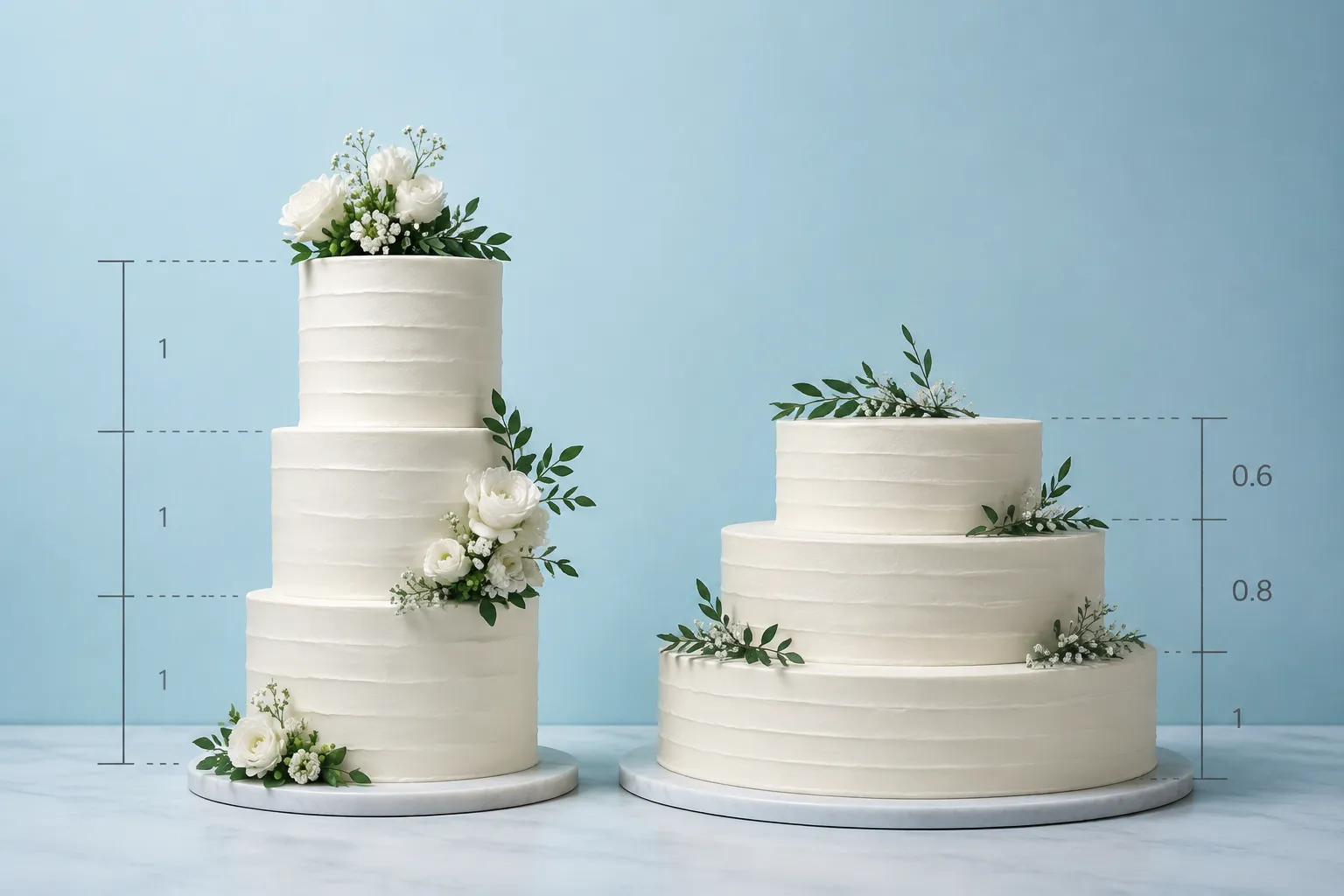
Tier ratio describes the relationship between width and height across the cake, not simply the number of tiers.
| Criterion | Option A: taller ratio | Option B: broader ratio |
|---|---|---|
| Visible effect | More vertical emphasis | More horizontal presence |
| Decoration space | Less width per tier, stronger vertical rhythm | More surface area for borders and focal details |
| Reference match | Supports an elongated silhouette | Supports a wider, more grounded profile |
| Main unknown | Whether the desired height is practical for the order | Whether the wider form weakens the intended profile |
| Bakery question | Which dimensions preserve the height-to-width relationship? | Which dimensions preserve the decoration spacing? |
Record the ratio as a relationship rather than a vague adjective. “The upper tier appears approximately half the diameter of the lower tier” is useful when the image makes that relationship clear. Do not turn a visual estimate into an exact specification without measured dimensions.
The number of tiers alone does not determine serving yield or structural feasibility. Those details belong in the bakery confirmation section.
Cake Finish and Edge Treatment
Finish describes how the surface reads and how decoration interacts with it. Useful labels include:
- Smooth and low-texture
- Softly ridged or spatula-textured
- Brushed or directional
- Patterned
- Layered with visible bands
- Matte-looking or glossy-looking
- Partially covered
A smooth finish can give small focal details more contrast. Texture adds surface information, but dense piping or lettering may become less distinct. A layered finish can make horizontal divisions central to the composition.
These are visual implications, not guarantees about technique. Decorating terminology can help name a finish, but it does not establish that a particular bakery can reproduce the reference or use the same method.
Finish Log Entry
- Observation: The reference shows a low-texture surface with a narrow decorative border.
- Implication: The border may carry more visible character than the base finish.
- Confirmation: Ask whether the border should remain narrow and whether the selected finish requires a different edge treatment.
Edges often determine whether a cake appears crisp, soft, formal, or handmade. Record the sharpness of the vertical corner, the softness of the top edge, any piped border, repeated ridges or folds, irregular marks, and whether the treatment continues around the full tier.
Avoid recording “clean” without specifying what it means. It may refer to a sharp corner, an uninterrupted surface, a narrow border, or consistent spacing. A sharply defined profile may compete with heavy piping, while an irregular edge may reduce the clarity of small lettering.
Piping Density, Scale, and Spacing
Piping density changes the visual weight of a tier. Compare one or two accent lines, repeated borders, clustered motifs, dense coverage, and focal clusters surrounded by open space.
Record the motif size and the gap between motifs. A reference can show dense decoration without establishing the number of piping passes, the nozzle, the material, or the labor involved.
Visible observation: The reference uses repeated piping along the lower edge, with open space above.
Planning implication: The lower tier appears visually heavier, directing attention upward.
Open confirmation: Ask whether the same density is wanted at the selected tier size, or whether the pattern should be simplified.
Scale changes when a detail moves from a reference image to a real cake. A small motif may lose separation on a larger surface, while a large focal detail may dominate a smaller tier. Ask the bakery to confirm finished dimensions and minimum spacing.
Focal-Detail Placement
Identify the first detail that attracts attention: a flower, topper, color contrast, lettering, geometric mark, or unusual edge.
- Position and relative size
- Contrast with the base
- Distance from nearby decoration
- Relationship to the cake’s centerline
- Visibility from the expected viewing direction
Placement can affect balance, lettering readability, and display decisions. A front-facing reference may not remain legible when the cake must be viewed from several directions.
Make the focal detail specific enough for the producing bakery to question or revise. Record whether its position is fixed, whether its size can change, and which surrounding space must remain open.
A Compact Observation and Implication Format
Use three lines for each important choice:
- Visible observation: What can be seen directly in the reference?
- Planning implication: What might this change in profile, finish, scale, placement, or decoration?
- Open confirmation: What must the producing bakery, venue, or responsible party verify?
This structure keeps an inference from becoming a fact and makes the log usable during a bakery handoff.
Questions to Send With the Brief
The final section should contain questions, not assumptions. Ask the producing bakery to confirm:
- Which silhouette and tier dimensions are feasible for the requested order?
- How closely can the visible profile, finish, and edge treatment be matched?
- Which details need simplification at the selected scale?
- What spacing is needed for lettering, piping, flowers, or other focal details?
- Will the requested layer visibility be part of the final construction?
- Which ingredients, fillings, finishes, and decoration materials are proposed?
- Are there ingredient or allergen requirements that need separate handling?
- What storage and temperature-control conditions apply?
- What transport and setup conditions need to be planned?
- Does the venue have food-contact, display, equipment, or decoration restrictions?
- Which parts of the reference are fixed choices, and which may vary?
- What price, availability, serving plan, and delivery details remain to be confirmed?
The FDA Food Code offers general context for food handling, storage, and temperature-control boundaries. Local rules, venue policies, and bakery procedures may differ, so order-specific conditions require confirmation from the responsible parties.
When the Reference Is Not Enough
A reference image leaves important gaps when it hides the side profile, crops the base, uses strong lighting, or shows only one viewing angle. Decoration may also conceal the layer structure, and an image may represent an illustrative or non-final direction rather than a finished cake.
- Side profile not visible.
- Finish may be affected by lighting.
- Tier dimensions are not provided.
- Layer visibility cannot be confirmed from this angle.
- Ingredients, taste, servings, price, and stability are not established.
- The reference is a visual direction, not a confirmed order specification.
When a detail cannot be inspected, leave it open instead of filling the gap with a confident description.
Final Decision-Log Entry
Chosen direction: Use the taller tier ratio, restrained piping, softly defined edges, and one focal detail on the front-facing upper tier.
Reason: This preserves the reference’s vertical profile and keeps the decorative area readable.
Revision point: Reduce piping density if the selected tier dimensions leave insufficient spacing.
Bakery confirmation: Confirm feasible tier dimensions, finish method, focal-detail size, ingredients, storage, transport, venue requirements, price, availability, serving plan, and delivery arrangements.
A cake planning decision log does not promise an identical finished cake. It makes the visible choices, practical tradeoffs, and unresolved production questions clear enough to revise the brief and request a grounded confirmation.