
Unknowns, Assumptions, and Decision Tracking
A cake planning checklist becomes useful when it records more than a preferred color or reference image. It should show what the image communicates, what the client is assuming, which options remain open, and what the producing bakery still needs to confirm.
This is the middle stage between inspiration and a confirmed order. The aim is to make the next bakery conversation clearer, without treating a reference as a complete production specification.
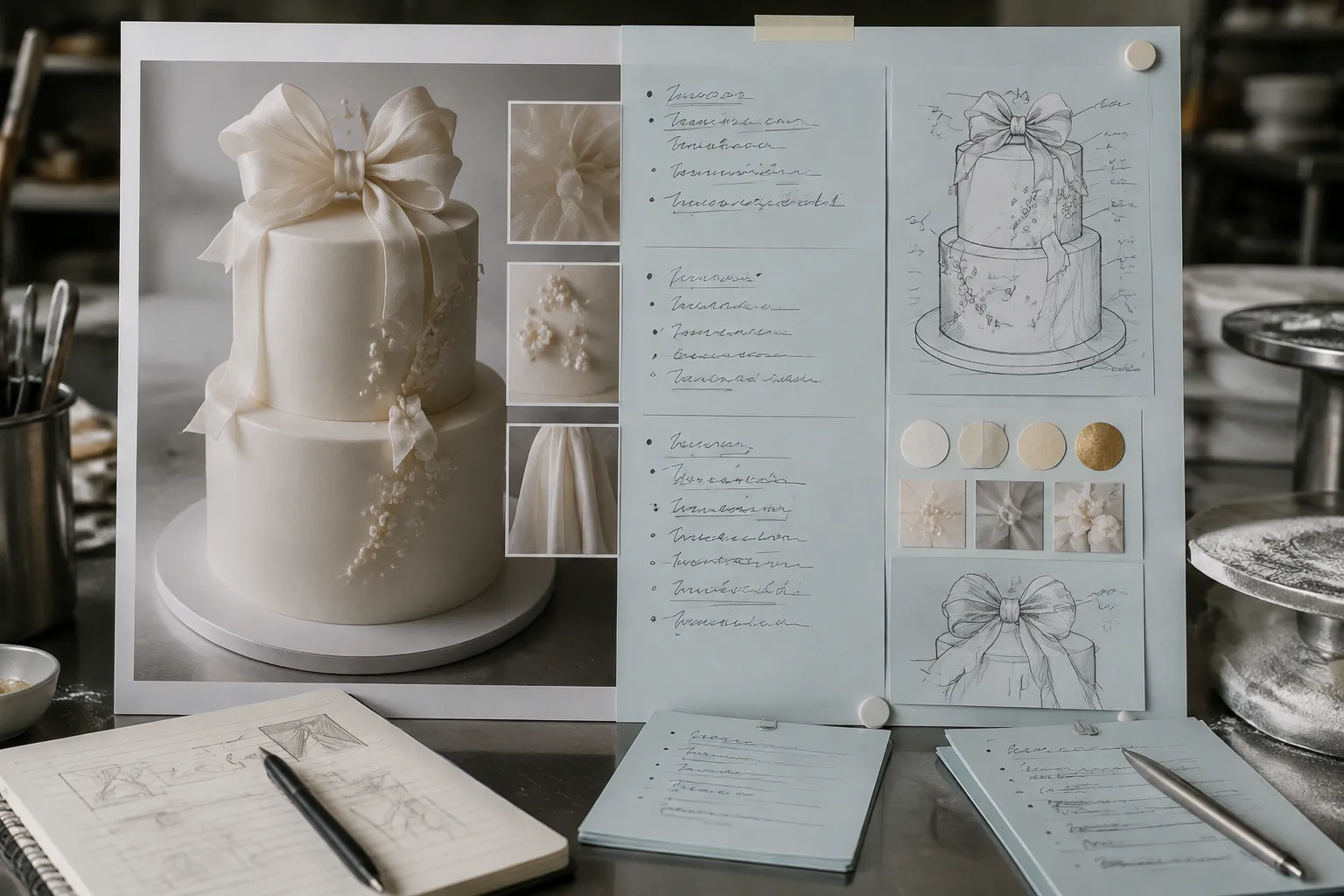
More specific pages
These pages continue the topic in smaller, more specific directions.
What a Cake Planning Checklist Should Track
A practical checklist separates four kinds of information:
- Visible target: what the reference visibly shows.
- Design choice: what the client wants to keep, change, or compare.
- Assumption: what is being treated as workable before confirmation.
- Unknown: what could change the option or requires a bakery or venue answer.
A photograph may show a tall silhouette, a narrow tier ratio, a smooth finish, dense piping, or a particular focal detail. The image does not establish ingredients, internal construction, serving quantity, price, availability, transport conditions, or venue acceptance.
A Simple Recording Structure
Use one row for each meaningful question rather than one row for every decorative detail. The purpose is to preserve the difference between an observation and a conclusion.
| Planning item | Current note | Status | Confirmation needed |
|---|---|---|---|
| Silhouette | Two-tier cake with a narrow upper tier | Observed | Confirm suitable proportions for the requested size |
| Finish | Smooth pale coating with a sharp-looking edge | Design direction | Ask which finish options are available |
| Focal detail | Large topper placed slightly off-center | Preferred choice | Confirm material, scale, and placement |
| Dietary requirement | Still being defined | Unknown | Confirm ingredients and handling with the bakery |
| Transport | Destination and timing not recorded | Unknown | Confirm with the bakery and venue |
| Budget | Working range only | Assumption | Confirm whether the selected details fit the range |
Cake Planning Unknowns: What Has Not Been Decided
Unknowns are unresolved details, not necessarily problems. Some affect the appearance directly; others affect whether the selected direction can be produced, stored, moved, displayed, or accepted at the venue.
Visual Unknowns
References often leave important details open. Record questions such as:
- Is the edge genuinely sharp, or does the lighting create that impression?
- Is the finish smooth, textured, brushed, or covered with another decorative layer?
- Is the topper edible, removable, or an illustrative prop?
- Is the color consistent across the cake, or affected by shadow and reflection?
- Is the piping fine and dense, or simply viewed at a small scale?
- Are the tiers balanced for appearance, or does the reference use a different proportion?
- Is the focal detail intended to remain off-center, or can its placement change?
These questions translate broad words such as “clean,” “soft,” or “modern” into edge shape, finish, piping density, spacing, scale, and placement.
Order Unknowns
A cake planning checklist should also flag details that appearance cannot answer:
- Which flavors and fillings are available?
- Are dietary requirements part of the brief?
- What serving quantity is required?
- What storage conditions apply before the event?
- How will the cake be transported?
- Can the venue receive, store, assemble, or display it?
- Is the requested date available?
- Which decorative materials can the bakery source and use?
- What price range applies to the selected size and finish?
Ask the producing bakery or venue to confirm these details. They should not be inferred from a photograph.
Unknowns That Can Change the Design
Place decision-changing questions near the top of the log. A different tier ratio, finish, topper, serving quantity, budget range, delivery window, dietary requirement, or venue restriction may require a revised silhouette, scale, material, or decorative route.
Cake Planning Assumptions: State Them Before They Spread
An assumption is a working statement used before it has been confirmed. Writing it down gives the producing bakery something specific to accept, revise, or reject.
- “The reference is being used for silhouette and finish direction only.”
- “The topper may be replaced with a suitable alternative.”
- “The requested tier ratio is a visual preference, not a confirmed construction.”
- “The color should remain within the same general family, subject to the available finish.”
- “The event venue may have separate requirements for delivery and display.”
- “The working budget does not yet include every decorative detail.”
- “The reference may be illustrative rather than a photograph of a final order.”
A preference leaves room for production review. “The brief prefers an edge with this visual character” is more accurate than treating the pictured edge as settled.
Three Useful Assumption Labels
- Low-impact assumption
- A detail that can change without affecting the main brief, such as a small placement adjustment.
- Design-sensitive assumption
- A detail that changes visual balance, such as tier ratio, edge profile, piping density, or focal scale.
- Order-sensitive assumption
- A detail requiring producer or venue confirmation, such as ingredients, dietary needs, servings, storage, transport, price, availability, or venue requirements.
This classification keeps attention on the questions with the greatest effect. Not every unknown needs the same review time.
Cake Planning Options: Compare Paths, Not Isolated Details
Comparing cake options works better when each route is judged against the same criteria. The useful question is not which design is universally better, but what each route changes.
Option A: Quiet Finish, Strong Silhouette
This route gives more attention to profile, tier spacing, and surface finish. With limited decoration, changes to the silhouette remain easy to see.
Reference signals: restrained surface, clear negative space, visible tier ratio, one or two focal details, and limited piping.
Planning consequence: small changes in edge shape, spacing, or topper scale may become prominent because the surface has fewer competing details.
Record: which profile is essential, how much edge variation is acceptable, whether the focal detail must keep its position, and whether the bakery recommends another proportion for the requested size.
Option B: Layered Decoration, Softer Silhouette
This route places more emphasis on piping, texture, color variation, or repeated details. The surface carries more visual information, so the underlying profile may be less exposed.
Reference signals: denser piping, several decorative layers, repeated motifs, a textured finish, or a less visible cake profile.
Planning consequence: density, spacing, scale, and placement need clearer wording than a general request for “more detail.”
Record: whether the piping is fine, broad, sparse, or dense; which detail is focal; whether the finish remains uniform behind the decoration; and whether the motif can vary while retaining its visual rhythm.
Option C: Statement Topper or Focal Object
This route makes one feature dominant, such as a topper, plaque, floral arrangement, figure, or sculptural accent.
Reference signals: a focal object positioned centrally or off-center, a clear relationship between topper and cake height, and contrast between the object and base finish.
Planning consequence: the focal object can affect visual balance, overall height, material choice, and display arrangement. The image does not establish whether it is edible, removable, suitable for food contact, or available from the producing bakery.
Record: material, intended use, visually important scale, placement, venue requirements, and whether the bakery can produce or source the requested form.
Comparison Table for Cake Design Choices
| Criterion | Quiet finish | Layered decoration | Focal topper |
|---|---|---|---|
| Main visual signal | Silhouette and spacing | Surface detail and texture | Scale and placement of one feature |
| Reference evidence | Profile is easy to inspect | Detail density carries more weight | Topper relationship is prominent |
| Main unknown | Edge and tier ratio | Piping method and spacing | Material, scale, and placement |
| Likely revision point | Proportion | Density or motif | Size or position |
| Bakery question | Which profile is feasible? | Which finish routes are available? | What can be produced or sourced? |
| Venue question | Display space | Handling and presentation | Material and display requirements |
This is a comparison tool, not a prediction of the finished order. Feasibility depends on the complete brief and the producing bakery’s confirmation.

Cake Planning Feasibility Questions
Feasibility questions connect a visual preference to a practical decision before the route is treated as settled. They do not promise that a reference can be reproduced as shown.
- “The brief prefers this narrow tier ratio. Which proportion is suitable for the requested size?”
- “The reference shows a smooth, sharp-looking finish. Which finish can the bakery provide for this order?”
- “The topper is visually important. What material and placement options are available?”
- “The design includes several small details. Which ones should remain if the brief needs to be simplified?”
- “The event requires a particular serving quantity. Which design adjustments would change the visual balance?”
- “The venue has limited storage space. What information does the bakery need before confirming the design?”
- “Which venue requirements should be checked before the order is finalized?”
Research on food-safety documentation, bakery process design, event capacity, collaborative requirements, and purposeful prototyping can support this type of structured questioning. It offers planning mechanisms, not order-specific answers. The producing bakery and venue remain responsible for confirming ingredients, handling, storage, transport, servings, price, availability, and display conditions.
Group Questions by Decision Stage
Before choosing a direction
- Which silhouette is preferred?
- Which finish matters most?
- What is the focal detail?
- Which reference elements are essential, optional, or replaceable?
Before requesting a quotation
- What size and serving quantity are required?
- Which flavors, fillings, and dietary requirements need confirmation?
- What decorative materials are being considered?
- What date, timing, storage, and transport details apply?
Before confirming the order
- Which design elements has the bakery accepted?
- Which assumptions remain open?
- What price and availability details have been confirmed?
- What does the venue need to approve or provide?
- Which details may change during production?
Before the event
- What storage and handling instructions has the bakery provided?
- Who receives the cake?
- Where will it be displayed?
- Are any topper or decorative elements removed before serving?
- Which remaining questions belong to the venue rather than the bakery?
Keep answers dated or versioned when the brief changes. Decision tracking is most useful when it shows what changed, why it changed, and who still needs to respond.
Building a Cake Planning Decision Log
A Cake Planning Decision Log can be a document, spreadsheet, or shared message. Its format matters less than its ability to preserve decisions and unresolved questions.
| Field | Purpose |
|---|---|
| Decision area | Groups the item by silhouette, finish, decoration, size, timing, or venue |
| Reference evidence | Records what can actually be seen |
| Preferred option | States the current direction |
| Alternatives | Keeps plausible routes visible |
| Assumption | Shows what has not been confirmed |
| Unknown | Names the unresolved question |
| Consequence | Explains what may change if the answer differs |
| Owner | Identifies whether the client, bakery, or venue must answer |
| Status | Marks the item as open, discussed, confirmed, or revised |
| Next action | States the next useful question or decision |
The consequence field explains why an unresolved detail matters without pretending to know the outcome:
- If the preferred topper cannot be used, the focal detail may need a different scale.
- If the requested serving quantity changes, the tier ratio may need revision.
- If the venue restricts certain display materials, the decorative route may change.
- If the preferred finish is unavailable, the brief can preserve color and spacing while changing the surface method.
Cake Planning Bakery Handoff: What to Send
A bakery handoff should be short enough to scan and complete enough to support a useful response.
- Event context: date, timing, venue, and relevant display conditions.
- Visual priority: silhouette, finish, color, piping, topper, spacing, or another visible feature.
- Reference status: whether each image is a finished cake photograph, documented example, illustrative image, or generated or non-final preview.
- Preferred option: the current direction and one acceptable alternative.
- Known constraints: serving needs, budget range, dietary requirements, timing, transport, storage, and venue information where known.
- Open questions: details requiring bakery or venue confirmation.
- Revision boundary: what can change and what should remain visually important.
The preferred direction is a two-tier cake with a tall profile, a light smooth finish, and one focal topper. The reference is being used for silhouette, spacing, and finish direction only. The tier ratio, topper material, ingredients, serving quantity, storage, transport, price, availability, and venue requirements remain open. Please identify which details are feasible, which need adjustment, and which information you need before confirming the order.
This wording separates a client preference from a bakery commitment. It also gives the producer a clear place to respond.
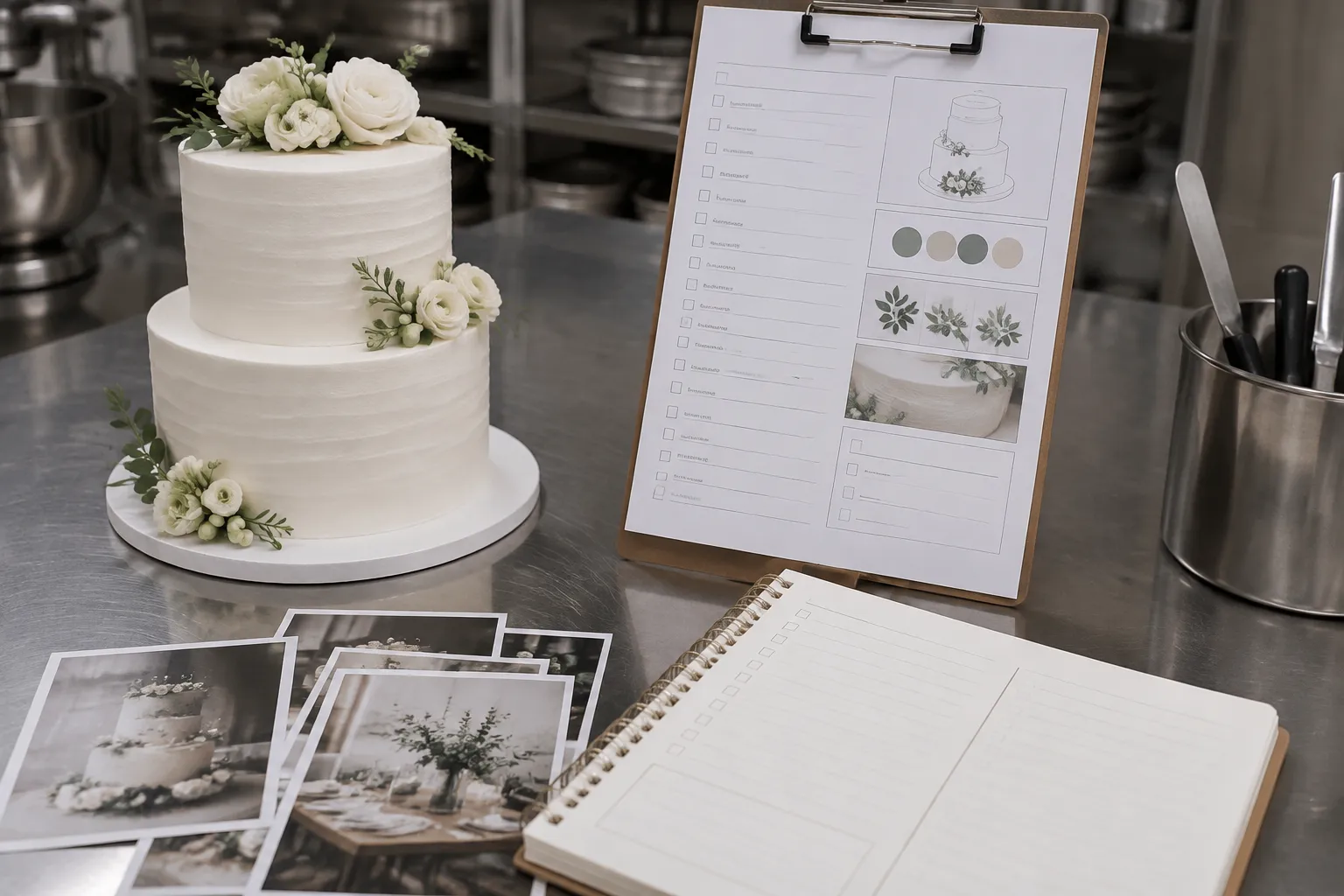
Common Mix-Ups in Cake Planning
A Reference Image Is Treated as a Specification
A reference communicates appearance. It may not identify internal composition, dimensions, materials, production route, or order conditions. Record it as evidence of a visual direction, then list the details requiring confirmation.
A Preference Is Treated as a Requirement
“Keep the same general profile” differs from “use the same proportions.” Mark each item as essential, preferred, flexible, or unknown so the bakery can suggest a workable variation without losing the main brief.
An Assumption Is Hidden in a Short Adjective
Words such as “simple,” “luxury,” “clean,” or “soft” can describe several choices. Translate them into observable details: “clean” may mean low piping density, a consistent finish, or generous spacing; “soft” may refer to color, rounded edges, floral placement, or reduced contrast.
An Option Is Chosen Before Constraints Are Recorded
A design can look suitable in a reference and still require revision when size, serving needs, venue conditions, timing, or budget are added. Record constraints before calling an option final.
A Bakery Question Is Confused With a Venue Question
The bakery may need to confirm ingredients, fillings, materials, production details, price, and availability. The venue may need to confirm storage, display, access, and local requirements. Keep these owners separate.
“Confirmed” Means Visually Resolved
A client may confirm a preferred design while production details remain open. Use separate statuses:
- Visually preferred
- Discussed
- Bakery-confirmed
- Venue-confirmed
- Still open
- Requires revision
A Practical Review Before Sending the Brief
- Check the visible evidence. Can another reader tell what comes from the reference and what comes from interpretation?
- Check the decision family. Is the page comparing meaningful design paths, or listing isolated decorations?
- Check the unresolved items. Are questions about ingredients, dietary needs, servings, storage, transport, price, availability, and venue requirements recorded?
- Check the owners. Does each open question have a responsible answerer?
- Check the revision boundary. Does the brief explain what must remain and what may change?
- Check the status language. Are “preferred,” “assumed,” “discussed,” and “confirmed” being used distinctly?
A question without an owner can remain unresolved while the design appears to move forward. A status without a source of confirmation creates the same confusion in a different form.
Cake Planning Confirmation Questions
Design
- Which visible feature should remain the main focal point?
- Is the preferred silhouette fixed, or can the tier ratio change?
- Which finish characteristics matter most: smoothness, texture, edge shape, or color?
- Which decorative details are essential?
- Which details may be simplified or substituted?
Ingredients and Dietary Needs
- Which ingredients, flavors, and fillings are available for this design?
- How should dietary requirements be documented and confirmed?
- Are there ingredient or handling questions that need separate discussion?
- Which details should be verified through the bakery’s own documentation?
Size and Serving
- What serving quantity is required?
- Would the requested quantity change the proportions or layout?
- Which visual compromises might be needed if the size changes?
- What does the bakery recommend confirming before the design is fixed?
Storage and Transport
- What storage conditions apply before the event?
- What transport information does the bakery need?
- Does the venue have separate receiving or display requirements?
- Which details require bakery confirmation rather than visual inference?
Price and Availability
- Is the requested date available?
- Which design elements affect the quotation?
- Which materials or decorative details are included?
- What changes would require a revised quotation?
Venue
- Can the venue receive and store the cake?
- Are there restrictions on display materials or toppers?
- Does the venue require specific handling or documentation?
- Who has final responsibility for confirming venue conditions?
When to Keep Comparing Options
Continue comparing options when the main focal detail is not agreed, the reference is unclear or non-final, the requested size may change the silhouette, or the finish is described only with broad adjectives.
Comparison also remains useful when a dietary or venue requirement could alter the design, the budget is still an assumption, the bakery has not confirmed the production route, or the client is choosing between different levels of decoration.
A comparison is useful while it can change the decision. Once one route is visually preferred and the remaining work consists of producer confirmation, move the open items into the handoff section.
When to Stop Comparing
The middle-stage brief is ready to hand off when it contains:
- one current preferred direction;
- one or more acceptable alternatives where needed;
- the visual details that matter most;
- a list of assumptions;
- the unknowns that could change the choice;
- clear feasibility questions;
- the responsible bakery or venue for each confirmation;
- a defined boundary for acceptable revision.
At that point, the brief does not need to predict the finished cake. It needs to help the producing bakery respond accurately. Mark the visible choice; confirm the production detail.
Sources
These sources support bounded planning ideas such as documentation, feasibility review, staged decisions, collaboration, prototyping, and material verification. They do not establish order-specific facts about a particular cake, bakery, ingredient set, serving quantity, price, transport arrangement, or venue.
- Implementation of HACCP Management System in a Cake Manufacturing Company in Dhaka, Bangladesh: A Case Study
- Quality prediction of bakery products in the initial phase of process design
- A decision framework for planning event catering with capacity and service synchronization
- AINeedsPlanner: A Workbook to Support Effective Collaboration Between AI Experts and Clients
- Prototyping Canvas: Design Tool for Planning Purposeful Prototypes
- Decision Tree of Materials: A Model of Halal Control Point (HCP) Identification in Small-Scale Bakery to Support Halal Certification