
Cake Silhouettes and Tier Proportions
Choosing between cake shapes is rarely only a choice between round, square, tall, or low. The visible silhouette also depends on tier ratio, edge treatment, spacing, finish, and the placement of the strongest decorative detail.
Begin with what the reference shows. Then separate that visual direction from the details the producing bakery still needs to assess, including dimensions, internal construction, serving requirements, transport, venue conditions, and finish feasibility.
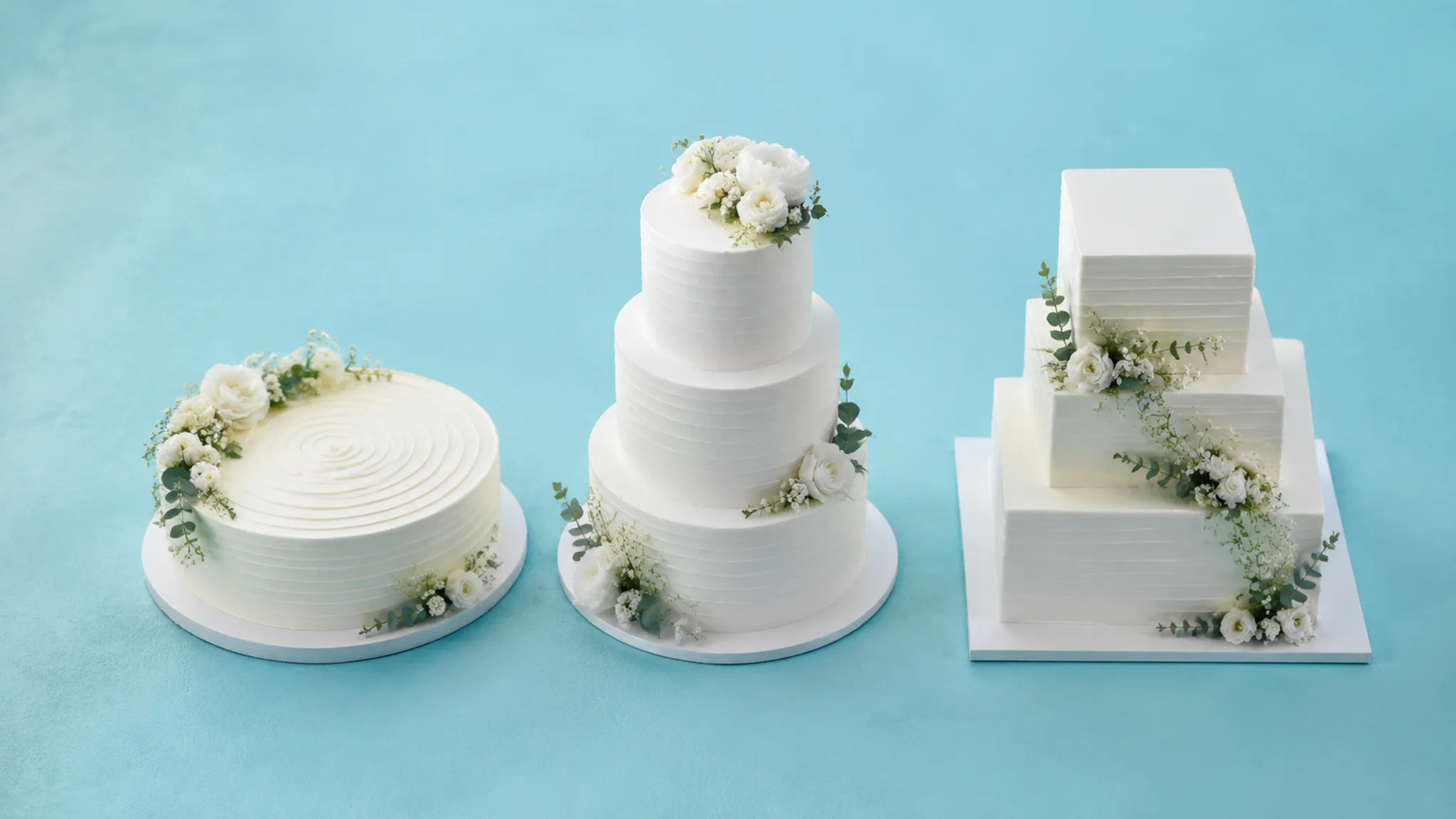
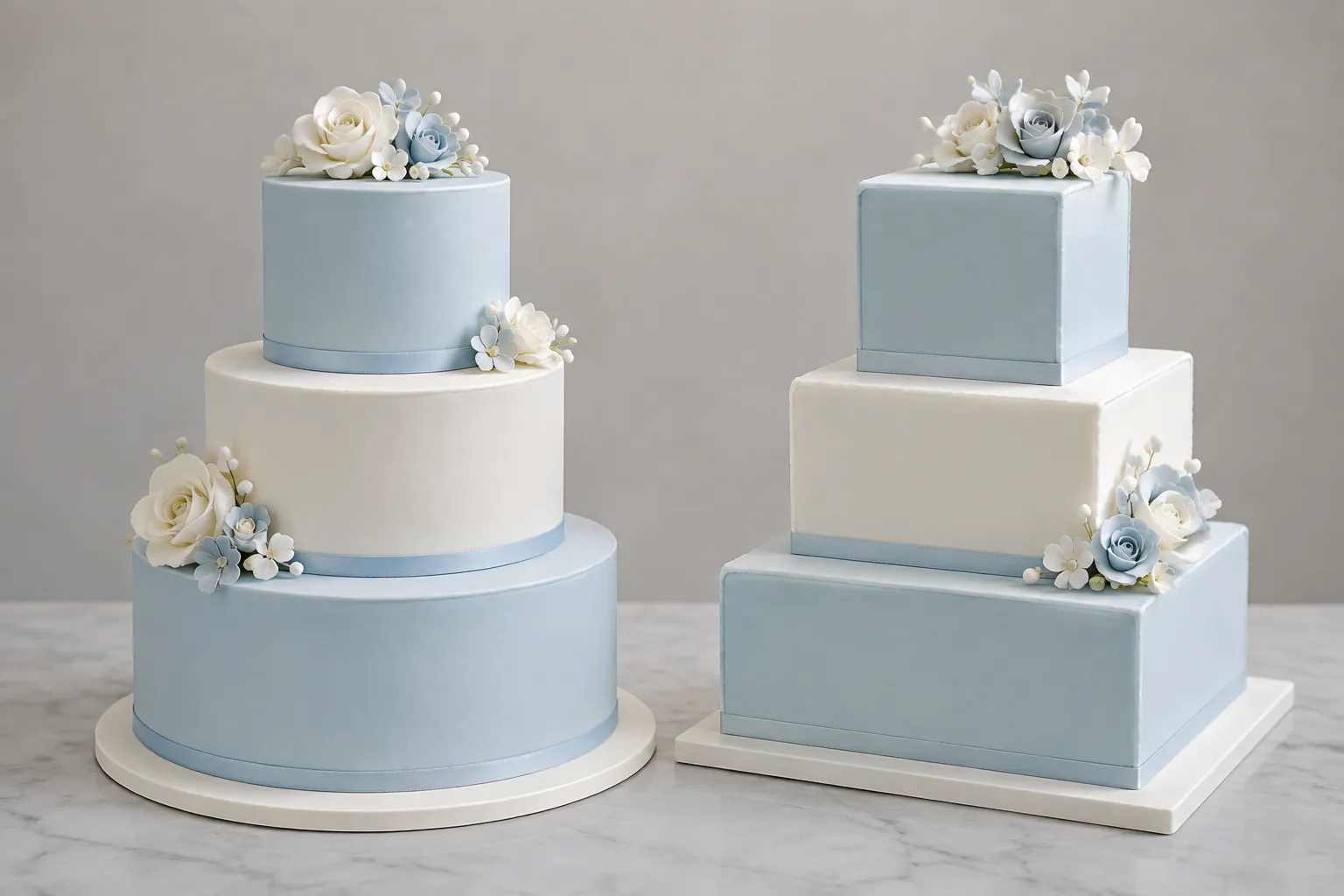
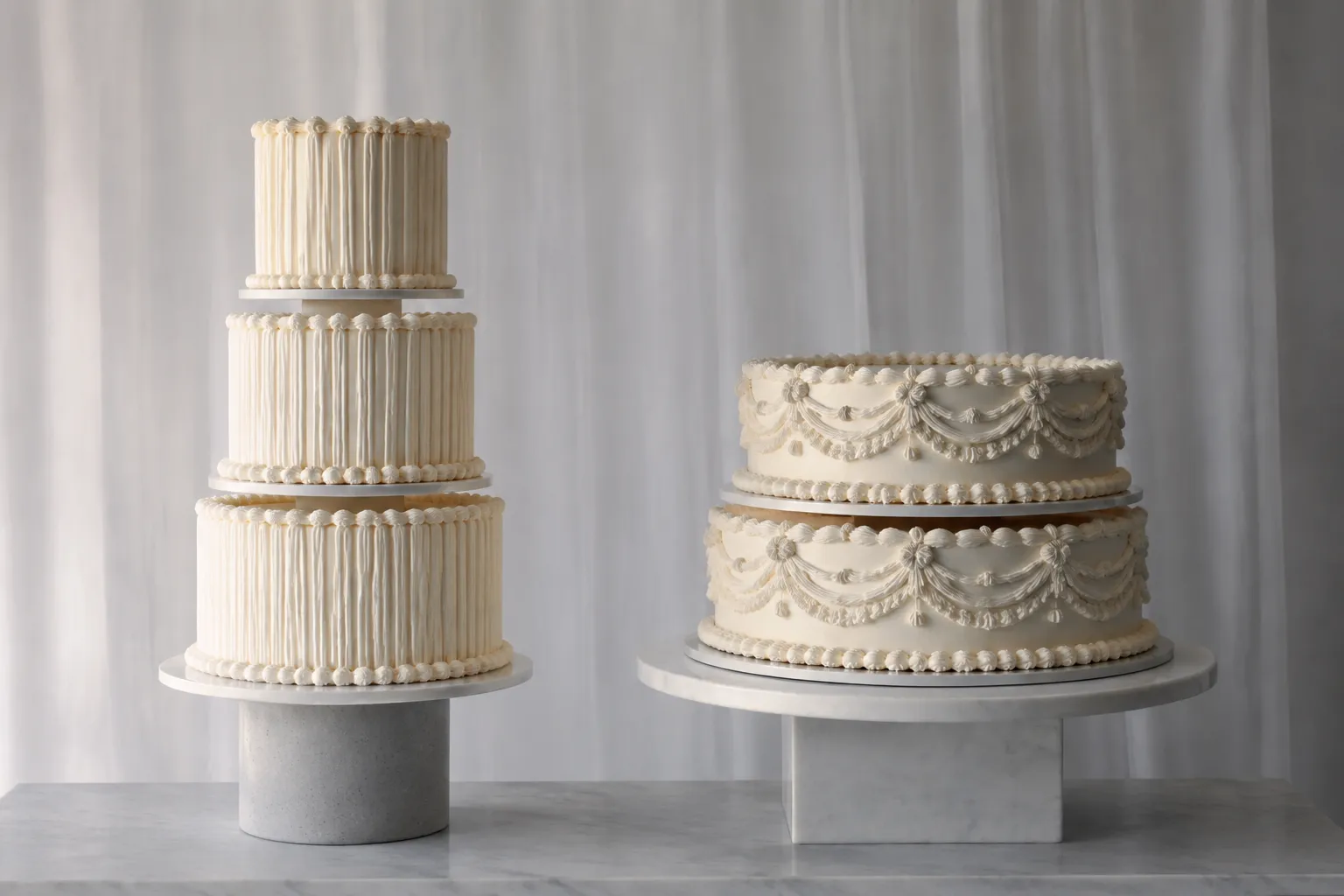
What a Cake Silhouette Includes
A cake silhouette is the combined outer profile of the finished cake. It includes the width and height of each tier, the transition between tiers, the edge shape, and the way decoration changes the outline.
- Low and broad
- Tall and narrow
- Evenly stacked
- Gradually tapered
- Softly rounded
- Straight-sided and geometric
- Layered with visible spacing
- Visually dense because tiers sit close together
These labels become useful when they are tied to visible details. Instead of writing “make it elegant,” a brief might specify a narrow upper tier, a wider lower tier, clean vertical sides, limited spacing, and one focal detail near the top.
The reference does not establish the recipe, filling, support system, serving yield, transport performance, venue acceptance, or exact finished dimensions. Those details require confirmation from the producing bakery and, where relevant, the venue.
Cake Shapes and the Decisions They Change
Round Tiers
Round tiers create a continuous curved outline. Their circular footprint can make wrapping decoration feel natural, while the edge may read as soft or sharply defined depending on the finish.
Compare round options by noting whether the sides are vertical or tapered, whether the top edge is crisp or softened, whether the diameters contrast, and whether piping follows the curve or interrupts it.
A round profile can support a continuous surface treatment, but the image does not reveal the exact coating, filling, or internal construction. Ask the bakery which edge definition and finish suit the requested scale and decoration density.
Square Tiers
Square tiers introduce corners, planes, and directional lines. The corners may carry much of the visual identity, particularly when the surface is plain or decoration follows the edges.
- Corner sharpness
- Side-to-side symmetry
- Direct or rotated alignment between tiers
- Whether piping turns at the corners
- Whether details sit on faces, corners, or both
- How much space remains between tiers
Straight sides and corners can make small contour differences easier to see. Research on baked cake products measures features such as contour, height, symmetry, and uniformity, but it does not establish a universal preference for square or round celebration cakes.
The producing bakery should confirm the achievable corner definition and surface finish at the intended scale.
Tall and Narrow Profiles
A tall, narrow profile gives the cake more vertical emphasis. A relatively small footprint, visible height, and limited overhang can make the tier arrangement read as formal or architectural.
Describe the relationship rather than relying on broad adjectives: a narrow base compared with total height, a small upper tier, close spacing, limited overhang, and decoration arranged along a vertical path.
The reference communicates an intended height-to-width relationship, but it cannot prove final height. Research shows that contour and volume may change during baking, and that baking or formulation conditions can influence the final profile. For the brief, state the visual target and leave the achievable dimensions and support details for bakery confirmation.
Low and Broad Profiles
A low, broad profile places more visual weight across the horizontal axis. Decoration may spread across the surface rather than extending upward, and the lower tier may carry most of the composition.
Compare the lower tier width, visible tier heights, horizontal piping, spacing between focal details, and the amount of vertical extension above the top tier.
Neither a tall nor a low profile is universally more suitable. The choice depends on the brief, display area, serving plan, transport conditions, and what the bakery can produce under the actual requirements.
Tier Proportions: The Main Variables
Tier proportions describe how the widths, heights, and spacing of tiers relate to one another. They are separate from the shape of an individual tier.
A round cake can have even, top-heavy, or strongly graduated proportions. A square cake can use the same broad relationships. Shape names the form; tier ratio explains how the forms work together.
Width Ratio
Compare the visible width of each tier from bottom to top. The lower tier may carry most of the width, or the changes may be subtle and evenly distributed.
Write the relationship plainly: “The lower tier carries most of the width, while the upper tier is set back enough to create a visible step.” The image can show an apparent width ratio, but it cannot establish exact measurements, serving capacity, or the quantity of cake required.
Height Ratio
Two cakes can use similar widths and still read differently because their tier heights differ. A short, wide tier and a tall, narrow tier create distinct profiles even when their overall diameters are similar.
Compare the height of each tier, the total cake body, the relative height of the top and bottom tiers, and the amount of decoration above the top surface. Academic measurements of height, volume, symmetry, and uniformity help explain why a final contour may need verification, but they do not provide a fixed rule for celebration-cake proportions.
Spacing and Tier Transitions
The transition between tiers affects whether the stack reads as compact, layered, or vertically separated. Record whether there is no visible gap, a narrow separator, a broad display space, or decoration bridging the transition.
A generated or non-final preview may suggest spacing without accurately representing construction. Treat it as a visual reference, then ask the bakery what spacing, boards, separators, or supports are appropriate for the requested design.
Overhang and Alignment
Overhang is the visible amount by which one tier extends beyond the tier above it. Alignment describes whether tiers share a center or shift relative to one another.
- Centered or slightly offset tiers
- Repeated or unequal offsets
- Equal or unequal overhangs
- Aligned or rotated corners
- Decoration that emphasizes or softens the alignment
The reference shows the intended visual relationship. It does not confirm structural performance or transport conditions, which remain production questions.
Compare Cake Shapes Using the Same Criteria
Repeated criteria keep one visible feature from hiding a constraint elsewhere. Use the same comparison points for both options.
| Criterion | Round profile | Square profile | Brief question |
|---|---|---|---|
| Outer line | Continuous curve | Straight sides and corners | Which outline should remain visible from a distance? |
| Edge reading | Soft, curved, or rolled | Defined, planar, or corner-led | Should the edge be prominent or quiet? |
| Decoration path | May wrap around the surface | May follow faces or corners | Does the piping need to turn, stop, or stay directional? |
| Tier relationship | Often read through diameter changes | Often read through width and alignment | Should the stack feel continuous or clearly segmented? |
| Surface emphasis | Curvature and finish | Planes, corners, and spacing | Which surface needs the most attention? |
| Main unknown | Final contour and finish | Corner definition and alignment | What must the bakery assess before approval? |
This is a planning comparison, not a ranking. Keep the option that still fits the intended profile, decoration, display conditions, and production discussion.
Finish, Focal Detail, and Scale
Finish and Edge Treatment
A smooth finish makes the main form easier to read, so small changes at the edge become more visible. A textured finish can soften a geometric profile or make the same tier ratio appear more compact.
Specify whether the surface appears matte or reflective, whether the edge is straight or softened, whether texture runs vertically or horizontally, and whether it covers the corners or stays within the faces. The image does not establish the exact icing or coating material.
Piping and Borders
Piping changes both scale and rhythm. Repeated borders can separate tiers visually, while dense piping can make a narrow profile look heavier.
- Line width and density
- Direction and repetition
- Placement at the top, base, corners, or vertical seams
- Whether the pattern continues around the full tier
- Whether the focal point is the edge, transition, or upper decoration
Focal Detail and Spacing
A simple silhouette can still feel crowded when the main details are too large or too close together. Compare the largest visible detail, the strongest contrast, and the areas intentionally left quiet.
State the focal detail's location, approximate scale relative to the tier, distance from the nearest edge, spacing from repeated details, and whether it crosses a tier boundary. “Large” is relative; use the tier itself as the scale reference.
A Practical Comparison Route
- Read the outline first.
Set color and small decoration aside. Compare total height, width distribution, outer profile, and tier steps.
- Compare the tier ratio.
Note which tier carries the most width, whether height is evenly distributed, and whether the stack is symmetrical or intentionally offset.
- Check the edge and finish.
A sharp, rounded, textured, or piped edge can change how the same silhouette reads.
- Check decoration density.
Separate the cake body from the decoration. Count visual groups such as the focal detail, border, topper, texture, and quiet areas.
- Name the production unknown.
End with the question that could change the choice: finished height, corner definition, tier spacing, display footprint, support arrangement, or venue requirement.
Turn a Preference Into a Bakery Brief
Less Useful
“Make it modern, tall, clean, and elegant.”
More Usable
“Compare a tall, narrow profile with a lower, broader profile. Keep the upper tier visibly smaller than the lower tier, use clean vertical sides, leave a clear transition between tiers, and place the main decoration near the upper third. Please assess achievable finished height, tier dimensions, finish options, and display or transport constraints.”
The second version identifies the profile, tier ratio, edge treatment, spacing, focal-detail placement, and confirmation points. It does not infer ingredients, servings, price, availability, structural performance, or exact reproduction from a reference image.
Common Mix-Ups
Shape and Tier Ratio
“Round” describes the form of an individual tier. It does not say whether the cake is tall, low, evenly stacked, or strongly graduated. Write both: “round tiers with a broad lower tier, smaller upper tier, and moderate visible separation.”
Height and Vertical Emphasis
A cake may look tall because of narrow tiers, strong spacing, vertical decoration, or a slim topper. Compare the cake body separately from anything placed above it.
Decoration and Silhouette
Flowers, piping, ribbons, and toppers can alter the apparent outline. Compare the undecorated profile first, then assess how decoration modifies it.
Centered Decoration and Symmetry
A centered topper does not prove that the tiers are symmetrical. Describe tier alignment and decoration placement as separate decisions.
Visual Match and Final Specification
A reference communicates direction without fixing identical dimensions or construction. Use “similar profile,” “comparable tier ratio,” or “in the same visual direction” while production details remain open.
Decision Paths
Choose a Rounded Profile When
- Curved edges are central to the reference.
- Decoration needs to wrap around the tiers.
- The brief depends on a continuous outline.
- Corners would compete with the focal detail.
Mark the desired edge definition, surface finish, tier widths, and decoration density for bakery review.
Choose a Geometric Profile When
- Straight sides or corners carry the visual identity.
- Piping follows planes or corners.
- Tier alignment is part of the composition.
- Visible spacing and clear transitions support the design.
Leave corner treatment, alignment, finish, and decoration behavior at corners for confirmation.
Choose a Taller Ratio When
- Vertical proportion matters more than a broad footprint.
- The reference shows narrow tiers and visible upward spacing.
- Decoration follows a vertical path.
- The display setting can accommodate the intended height.
Ask the bakery to assess finished height, display clearance, support requirements, and handling conditions.
Choose a Lower Ratio When
- The design depends on a wide horizontal arrangement.
- The lower tier carries the visual weight.
- Decoration needs room to spread across the surface.
- A compact profile suits the display plan.
Record the footprint, serving plan, display area, and decoration scale that preserve the intended balance.
Review Sheet for Two Options
Record the same details for both options:
- Overall silhouette
- Individual tier shape
- Lower-to-upper width relationship
- Tier height relationship
- Visible spacing
- Edge treatment and surface finish
- Piping density
- Focal-detail location and scale
- Empty space
- Display footprint
- Open production question
Option A better matches the requested low, broad profile. Option B keeps the same focal detail but shifts the tier ratio toward a taller, narrower arrangement. Please assess which profile is practical for the required dimensions, display setting, and production method.
The handoff becomes clearer when it names the priority and the acceptable variation: keep the tier ratio even if the piping changes, or keep the square corners visible even if the surface texture changes.
Questions for the Producing Bakery
- Can the requested silhouette be produced at the proposed tier dimensions?
- Which edge finish best preserves the reference profile?
- How could the selected finish affect apparent tier height or spacing?
- Can the corners, curves, or offsets be made in the requested form?
- What internal construction or support details need assessment?
- Could the display setting change the practical height or footprint?
- What serving plan should inform the tier sizes?
- Could handling conditions change the recommended profile?
- Which parts of the reference are illustrative rather than specified?
- What should be revised if the requested dimensions are not feasible?
Final Handoff
A useful cake shape comparison identifies the visible profile, shows how the tier ratio changes it, and records the details that remain unresolved.
Send the bakery a brief naming the preferred silhouette, the alternative being compared, the tier width and height relationship, the edge and finish direction, the spacing between tiers, the scale and placement of focal details, and the production questions requiring assessment.
The reference settles the direction, not the finished result.
Sources
- Measurement of Contour and Volume Changes During Cake Baking - limited support for discussing changes in contour and volume during baking.
- The Impacts of Batter and Baking Temperatures and Baking Time on Sponge Cake Characteristics - supporting context for why baking conditions can affect final cake characteristics.
- The Effect of Wheat Flour Treated with Superheated Steam on the Microstructure and Rheological Behaviors of Batter and Cake Quality - limited technical context for formulation-related variation; it does not establish rules for celebration-cake silhouettes or tier construction.